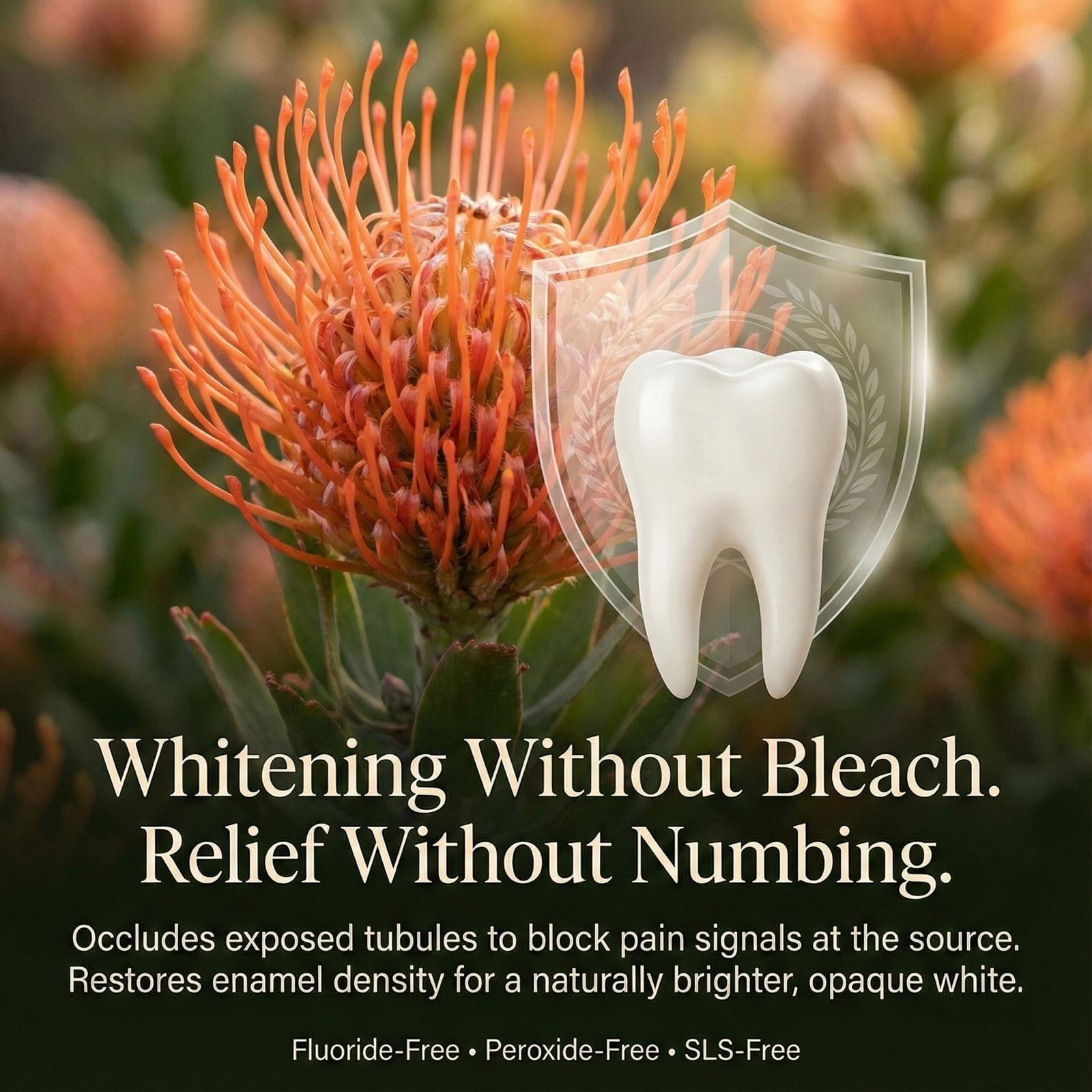
Peer-Reviewed Science
THE SCIENCE OF RENAMEL
Every claim we make about nano-hydroxyapatite and xylitol is grounded in peer-reviewed clinical trials and systematic reviews. Explore the evidence — and the full reference list — below.
The information presented about our ingredients is backed by peer-reviewed clinical studies — from 18-month randomised controlled trials to comprehensive systematic reviews. Research consistently shows nano-hydroxyapatite and xylitol matching or exceeding conventional treatments, while remaining safe for all ages.
Renamel® is a cosmetic product and this information is provided for education only.
The enamel rebuilder — a biomimetic mineral identical to natural tooth enamel, with decades of clinical research behind it.
Cavity prevention · 18-month RCT
89.3% of hydroxyapatite users had no new cavities — vs 87.4% with fluoride
An 18-month double-blind randomised clinical trial compared hydroxyapatite toothpaste head-to-head against standard fluoride toothpaste in adults — and found it just as effective at preventing caries.
Paszyńska et al., 2023 · see bibliography →
Pawinska et al., 2024 — updated systematic review and meta-analysis: hydroxyapatite users were 2.51× more likely to prevent caries vs placebo, with a slight edge over fluoride. Study link ↗
Wierichs et al., 2022 — systematic review: under remineralising conditions, nano-hydroxyapatite shows the same remineralising potential as fluoride. Study link ↗
Remineralisation · lab
143% enamel hardness recovery — vs 116% for fluoride
In laboratory testing of artificially damaged enamel, 7% nano-hydroxyapatite rehardened teeth more than a fluoride-only treatment under the same conditions — concluding it "was more effective than fluoride-only toothpaste for remineralisation."
Ebadifar et al., 2017 · see bibliography →
Juntavee et al., 2018 — "significantly higher capability for remineralisation" on enamel and root surface vs fluoride; electron microscopy showed n-HAp particles depositing directly into damaged areas. Study link ↗
Tschoppe et al., 2011 — higher remineralising effect on dentine than fluoride toothpaste; nano-hydroxyapatite's higher pH (6.94–7.39 vs 5.24) appears to favour deeper repair. Study link ↗
Sensitivity · double-blind RCT
Noticeably less sensitivity in just 2–4 weeks
With 15% nano-hydroxyapatite, participants reported significantly lower sensitivity to air and touch than both fluoride and placebo groups — by physically sealing the exposed dentinal tubules that cause discomfort.
Vano et al., 2014 · see bibliography →
de Melo Alencar et al., 2019 — meta-analysis of six randomised trials found a "better desensitising effect" and "better clinical performance than other treatments." Study link ↗
Hu et al., 2018 — meta-analysis of 53 controlled trials confirmed nano-hydroxyapatite relieves sensitivity by physically blocking dentine tubules. Study link ↗
Whitening · systematic review
Whitening through restoration — no peroxide, no bleaching
A review of 17 studies found nano-hydroxyapatite brightens teeth two ways: an immediate effect from filling micro-defects and adhering to enamel, plus a built-up white, light-scattering layer over time — all without the sensitivity of bleaching.
Limeback et al., 2023 · see bibliography →
Microbiome & mechanism
Up to 65% less bacterial load — and direct mineral deposition
A meta-analysis of enamel-sample studies showed hydroxyapatite reduced bacterial load by an average of 65% vs controls. And because it's the same mineral as 97% of enamel, it acts as a calcium-phosphate reservoir — keeping saliva super-saturated to drive remineralisation and inhibit demineralisation.
Pawinska et al., 2024 · Pushpalatha et al., 2023 · see bibliography →
Ionescu et al., 2020 — substituted nano-hydroxyapatite toothpastes significantly reduced early biofilm formation, with effects most pronounced at 12 hours. Study link ↗
Family-friendly: studies describe nano-hydroxyapatite as an "ideal substitute for fluoride … suitable for people of all ages," with naturally safe actives if accidentally swallowed.
Nature's bacterial fighter — a natural sweetener that actively starves cavity-causing bacteria and offers long-lasting protection.
Long-term protection · 2-year RCT
A "legacy effect": fewer new cavities up to 2 years after stopping use
High-risk children given high-dose xylitol for six months had significantly fewer new cavities even two years after they stopped — alongside reported reductions in plaque and mutans streptococci.
Campus et al., 2013 · see bibliography →
Janakiram et al., 2017 — systematic review and meta-analysis of 20 studies found xylitol significantly reduces caries incidence as a self-applied preventive agent. Study link ↗
Riley et al., 2015 — Cochrane review: fluoride toothpaste containing xylitol may reduce decay in permanent teeth by 13% over 3 years vs fluoride alone. Study link ↗
Plaque control · anti-microbial
Starves cavity-causing bacteria — a "futile energy cycle"
When harmful bacteria try to consume xylitol they become trapped in a futile energy cycle, "unwittingly contributing to their own death" — active anti-microbial action, not just a passive sugar substitute.
Nayak et al., 2014 · see bibliography →
Nasseripour et al., 2022 — meta-analysis of eight studies: xylitol gum "significantly reduced plaque quantity" through a direct anti-microbial effect on biofilm. Study link ↗
Söderling & Pienihäkkinen, 2025 — systematic review: "the best evidence of specific beneficial effects for xylitol gum" in lowering harmful bacteria and plaque. Study link ↗
Dosage · systematic review
Dose-dependent: higher doses, bigger benefit
A systematic review of dosage effects found studies using more than four grams of xylitol per day achieved a "medium caries reduction" — so meaningful concentrations matter, not just trace amounts.
Marghalani et al., 2017 · see bibliography →
Targeted, not blunt: xylitol selectively targets Streptococcus mutans — the main cavity-causing bacteria — while leaving beneficial oral bacteria largely unaffected, supporting a balanced oral microbiome.
The Research Verdict
Both nano-hydroxyapatite and xylitol deliver oral-health benefits backed by rigorous clinical research — from fluoride-equivalent caries outcomes and enamel rebuilding to xylitol's bacteria-fighting action and long-term protection — all while remaining safe for the whole family. Every study below is peer-reviewed and published in a respected dental journal.
Every study referenced on this site, in full. All sources are peer-reviewed and published in respected dental journals.
Campus, G., et al. (2013). Six months of high-dose xylitol in high-risk caries subjects—a 2-year randomised clinical trial. Clinical Oral Investigations, 17(3), 785–791. https://doi.org/10.1007/s00784-012-0774-5
de Melo Alencar, C., et al. (2019). Clinical efficacy of nano-hydroxyapatite in dentin hypersensitivity: A systematic review and meta-analysis. Journal of Dentistry, 82, 11–21. https://doi.org/10.1016/j.jdent.2018.12.014
Ebadifar, A., et al. (2017). Effect of nano-hydroxyapatite toothpaste on microhardness of artificial carious lesions created on extracted teeth. Journal of Dental Research, Dental Clinics, Dental Prospects, 11(1), 14–17. https://doi.org/10.15171/joddd.2017.003
Hu, M.-L., et al. (2018). Effect of desensitizing toothpastes on dentine hypersensitivity: A systematic review and meta-analysis. Journal of Dentistry, 75, 12–21. https://doi.org/10.1016/j.jdent.2018.05.012
Ionescu, A. C., et al. (2020). Substituted Nano-Hydroxyapatite Toothpastes Reduce Biofilm Formation on Enamel and Resin-Based Composite Surfaces. Journal of Functional Biomaterials, 11(2), 36. https://doi.org/10.3390/jfb11020036
Janakiram, C., et al. (2017). Xylitol in preventing dental caries: A systematic review and meta-analyses. Journal of Natural Science, Biology and Medicine, 8(1), 16–21. https://doi.org/10.4103/0976-9668.198344
Juntavee, N., et al. (2018). Remineralization potential of nano-hydroxyapatite on enamel and cementum surrounding margin of CAD/CAM ceramic restoration. International Journal of Nanomedicine, 13, 2755–2765. https://doi.org/10.2147/IJN.S165080
Limeback, H., et al. (2023). Tooth Whitening with Hydroxyapatite: A Systematic Review. Dentistry Journal, 11(2), 50. https://doi.org/10.3390/dj11020050
Marghalani, A. A., et al. (2017). Effect of xylitol on incidence of dental caries: systematic review and meta-analysis. Journal of Public Health Dentistry, 77(1), 16–26. https://doi.org/10.1111/jphd.12177
Nasseripour, M., et al. (2022). Effects of Xylitol and Polyol Chewing Gums on Salivary Biomarkers and Dental Plaque in Orthodontic Patients: A Systematic Review and Meta-Analysis. Frontiers in Oral Health, 3, 845921. https://doi.org/10.3389/froh.2022.845921
Nayak, P. A., et al. (2014). The effect of xylitol on dental caries and oral flora. Clinical, Cosmetic and Investigational Dentistry, 6, 89–94. https://doi.org/10.2147/CCIDE.S55761
Paszyńska, E., et al. (2023). Caries-preventing effect of a hydroxyapatite-toothpaste in adults: an 18-month double-blinded randomized clinical trial. Frontiers in Public Health, 11, 1199728. https://doi.org/10.3389/fpubh.2023.1199728
Pawinska, M., et al. (2024). Clinical evidence of caries prevention by hydroxyapatite: An updated systematic review and meta-analysis. Journal of Dentistry, 151, 105429. https://doi.org/10.1016/j.jdent.2024.105429
Pushpalatha, C., et al. (2023). Nanohydroxyapatite in dentistry: A comprehensive review. The Saudi Dental Journal, 35(6), 741–752. https://doi.org/10.1016/j.sdentj.2023.05.018
Riley, P., et al. (2015). Xylitol-containing products for preventing dental caries in children and adults. Cochrane Database of Systematic Reviews, 3, CD010743. https://doi.org/10.1002/14651858.CD010743.pub2
Söderling, E., & Pienihäkkinen, K. (2025). Effects of xylitol and other polyols on oral health: a systematic review. BMC Oral Health, 25, 74. https://doi.org/10.1186/s12903-025-06602-1
Tschoppe, P., et al. (2011). Enamel and dentine remineralization by nano-hydroxyapatite toothpastes. Journal of Dentistry, 39(6), 430–437. https://doi.org/10.1016/j.jdent.2011.03.008
Vano, M., et al. (2014). Effectiveness of nano-hydroxyapatite toothpaste in reducing dentin hypersensitivity: A double-blind randomized controlled trial. Quintessence International, 45(8), 703–711. https://doi.org/10.3290/j.qi.a32240
Wierichs, R. J., et al. (2022). Efficacy of nano-hydroxyapatite on caries prevention—a systematic review and meta-analysis. Clinical Oral Investigations, 26, 3373–3381. https://doi.org/10.1007/s00784-022-04390-4
Disclaimer: Renamel® is a cosmetic product. Research information is for educational purposes only. Individual results may vary. Consult your dental professional.