
The Research Revolution: Clinical Evidence That Rewrites Oral Care
After 70+ years of fluoride dominance, science has achieved something remarkable: ingredients that deliver comparable caries outcomes while adding benefits fluoride can't match. From the historic 18‑month study showing nano‑hydroxyapatite's 89.3% cavity‑free success to the discovery of how xylitol creates a metabolic energy trap for cavity‑causing bacteria, these findings are reshaping oral‑care possibilities.
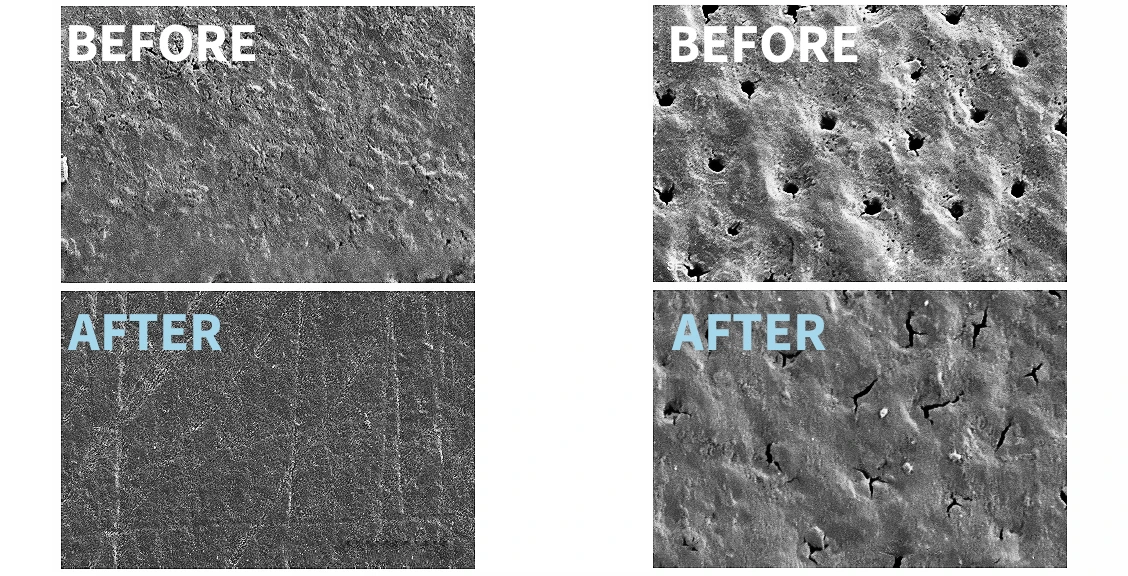
Electron microscope images of the effect of nano‑hydroxyapatite from Juntavee, N., et al. (2018).
For Dental Professionals
Looking for detailed research data, peer-reviewed studies, and technical analyses?
Research Page for Dental ProfessionalsEnamel Rebuilding: The "Calcium Phosphate Reservoir" Revolution
The Dramatic Recovery Numbers
Controlled remineralisation study (Ebadifar et al., 2017)
Teeth treated with 7% nano‑hydroxyapatite showed 143% recovery in hardness from the damaged state, while fluoride‑only achieved just 116% recovery—demonstrating superior remineralisation capability in laboratory testing.3
Beyond Repair: True Regeneration
This isn't just filling holes or coating surfaces. Research reveals nano-hydroxyapatite "acts as a calcium phosphate reservoir, keeping a state of super-saturation with regard to enamel minerals, enhancing remineralization and inhibiting demineralization."
Think of it as installing a sophisticated mineral supply system directly into your teeth—constantly feeding them the exact building blocks they need to stay strong and repair themselves.
The Perfect Biomimetic Match
- 97% Identical: Uses the exact same mineral that makes up 97% of your tooth enamel—perfect structural compatibility
- Microscopic Integration: Advanced imaging shows nano-hydroxyapatite particles depositing directly into damaged areas for true repair
- Progressive Strengthening: Every brush session adds to your mineral reservoir, making teeth progressively stronger
- "Extremely Capable": Research confirms it's "extremely capable in the remineralization process for enamel"
Visual Proof You Can See
Electron Microscope Evidence (Juntavee et al., 2018): Scientists can actually see nano-hydroxyapatite particles depositing into damaged tooth areas under powerful microscopes. The images show "significantly higher capability for remineralization" compared to fluoride treatments—visual proof of superior repair.
The Game-Changer: While fluoride primarily creates a protective barrier, nano-hydroxyapatite actually rebuilds your tooth structure from within. It's the difference between putting up a shield versus regenerating damaged tissue. You're not just preventing future damage—you're actively reversing existing damage and creating teeth stronger than they were before the damage occurred.
Cavity Prevention Research
What researchers set out to learn
Could a fluoride‑free toothpaste with hydroxyapatite deliver cavity outcomes comparable to fluoride, and how does it perform against a placebo in controlled studies?
What the studies tested
- Head‑to‑head adult trial: 18‑month, double‑blind study comparing hydroxyapatite toothpaste with a fluoride toothpaste under identical brushing routines.12
- Placebo‑controlled trials & reviews: Multiple studies and a meta‑analysis examining outcomes vs. placebo to understand the added benefit of hydroxyapatite.13
What they found
- In the adult head‑to‑head trial, cavity outcomes were comparable between hydroxyapatite and fluoride groups under study conditions (e.g., 89.3% vs. 87.4% with no increase in DMFS).12
- Across placebo‑controlled studies, people using hydroxyapatite toothpaste were more likely to avoid caries progression than those using a placebo.13
What this means for you
These findings support hydroxyapatite as a research‑backed, fluoride‑free option for everyday brushing. Outcomes always depend on brushing habits, diet, saliva, and regular dental care.
High‑impact actives: 10% nano‑hydroxyapatite • 10% xylitol
Many toothpastes use much lower amounts—Renamel® lists 10% n-HAp and 10% xylitol on pack.
Education only. Renamel® is a cosmetic product and does not claim to treat or prevent disease.
Sensitivity Relief: Fast & Lasting Results
Clinical Trial Results
Sensitivity studies (e.g., Limeback et al., 2023)
Within just 2‑4 weeks, participants experienced significantly lower sensitivity to air and touch compared to fluoride toothpaste, other desensitising alternatives, and placebo groups. Pain scores on standardised scales also dropped significantly in clinical studies.19
A Complete Solution, Not a Band-Aid
- Permanent Fix: Physically seals the microscopic channels (dentinal tubules) that cause sensitivity pain
- Gets Better Over Time: Unlike numbing treatments, relief improves with continued use as more tubules get sealed
- No Side Effects: Actually strengthens teeth while providing relief
Comprehensive Research Support
Systematic Review (de Melo Alencar et al., 2019): Analysis of six clinical trials found nano-hydroxyapatite treatments showed "better desensitizing effect" and "better clinical performance than other treatments for sensitivity relief."
Timeline You Can Expect:
- Week 1-2: Initial sealing begins with small improvements
- Week 2-4: Clinical studies show measurable pain reduction
- Ongoing: Continued improvement with daily use
Microbiome Science: let the bacteria destroy themselves
How It Works
Revolutionary Xylitol Research (Multiple Studies)
Metabolic energy trap: cavity‑associated bacteria take up xylitol but can’t use it efficiently, leading to reduced growth and acid production.
The Elegant Science
When Streptococcus mutans encounter xylitol, they take it up as if it were sugar. Because it cannot be metabolised efficiently, it creates an energy dead‑end that limits their growth and acid production.
The "Legacy" Effect
Groundbreaking Discovery (Campus et al., 2013): Children who used high-dose xylitol for just 6 months had significantly fewer new cavities even 2 years after stopping use. This "legacy protection" effect reveals something profound: xylitol doesn't just kill harmful bacteria temporarily—it fundamentally reshapes your oral microbiome for years to come.
Triple‑Layer Support
- Nano‑hydroxyapatite: Creates smoother, mineral‑rich surfaces that reduce plaque adhesion; lab studies report reduced early biofilm on enamel and composites.9
- Xylitol: Non‑fermentable; supports a less cariogenic environment via a metabolic energy trap
- Up to 65% bacterial load reduction: Reported in controlled studies under specific conditions
Balanced approach: Unlike broad antimicrobials, xylitol’s mechanism is selective, helping shift the oral environment toward balance.
Natural Whitening: Beauty Through Science
Whitening Research Review
Systematic review (Limeback, Meyer & Enax, 2023)
Analysis of 17 studies concluded: "regular use of hydroxyapatite‑containing oral care products effectively whitens teeth" through dual brightening mechanisms—immediate surface smoothing plus long‑term micro‑layer formation.8
Elegant Dual Mechanism
Analysis of 17 studies revealed how nano-hydroxyapatite creates both immediate and long-term whitening effects:
- Immediate Brightening: Fills microscopic surface imperfections, creating smoother surfaces that reflect light more evenly
- Long-Term Whitening: Builds up a white, opaque protective layer that blocks the natural yellow color of dentin from showing through
- Stain Prevention: The smoother, more mineralized surface makes it harder for new stains to stick
The Gentle Advantage
Unlike harsh bleaching chemicals that can damage enamel and cause sensitivity, nano-hydroxyapatite actually reduces sensitivity while whitening. Research shows it "not only makes the tooth appear whiter, but also blocks the reflection of incoming light off the darker yellow dentin."
Win-Win Results: The only whitening approach that makes your teeth both brighter and more comfortable—truly the best of both worlds for your smile.
Family Safety: Complete Peace of Mind
Safety Research Consensus
Multiple studies and reviews
Hydroxyapatite and xylitol are widely used in cosmetic oral‑care. As with any toothpaste, spit out after brushing. Supervise children and use a pea‑sized amount.
The End of Compromise
For decades, parents faced an impossible choice: effective cavity protection with fluoride safety concerns, or fluoride-free options that didn't deliver results. Clinical research proves we can now have both:
- Proven Effectiveness: Clinical trials show nano‑hydroxyapatite achieving comparable caries outcomes to fluoride
- Natural Safety: Active ingredients are naturally safe if accidentally swallowed (though we still recommend spitting out)
- Family-Friendly: Suitable for all ages with proper supervision of children during brushing
References: See full bibliography
Research-Backed Family Benefits
Scientific Consensus: Multiple studies emphasize nano-hydroxyapatite as the "ideal substitute for fluoride in toothpaste and mouthwash tailored for young children" while being perfect for adults too.
Natural Ingredients, Maximum Safety
- Nano-Hydroxyapatite: The exact same mineral that makes up 97% of tooth enamel—completely natural and safe if accidentally ingested
- Xylitol: Found naturally in fruits and vegetables, with decades of safety research showing it's safe even if swallowed
- Probiotics: Beneficial bacteria that support oral health, naturally safe for the whole family
- Complete Formula: Every ingredient chosen for both effectiveness and safety
This Changes Everything: No more reading poison information centre warnings, no more worrying about accidental ingestion during brushing, no more compromising between safety and effectiveness. Just pure, proven protection with naturally safe active ingredients for every member of your family.
The Science That Changes Everything
These aren't marketing claims—they're research‑backed findings. From xylitol’s metabolic energy trap to head‑to‑head trials showing hydroxyapatite can match fluoride’s cavity outcomes under study conditions, each story is backed by rigorous, peer‑reviewed research.
The "calcium phosphate reservoir," the "143% recovery advantage," the "legacy" benefits seen years after use—these findings reflect decades of progress on nano‑hydroxyapatite and xylitol.
Every claim referenced to published studies. See the full bibliography for details.